For those who are interested, a brief, not-terribly-exhaustive catalogue of the things I did and did not do over my week-long excursion into the wilds of northeastern Israel.
Did: Sleep on the back of a tank. Solo hike through the Yehudiyeh Nature Preserve living on peanut butter and pita. Almost fall off a mountain/die of exposure.
Did not: Actually fall of mountain/die of exposure.
Did: Get hit on by fourteen-year-old Israeli girls bathing suggestively together--you couldn't make this up--in a waterfall.
Did not: End up in Israeli jail on charges of statutory rape.
Did: See a variety of strange animals, including wild pigs, foxes, and cliff-climbing waterfowl.
Did not: Despite how sick I was of peanut butter and pita, catch and eat them.
Did: Try.
Did: Try to pick cactus fruit using a T-shirt to avoid the spines.
Did not: Succeed, or manage to salvage shirt.
Did, in Tzfat: Illegally explore an archaeological dig. Get followed around for two separate days by a stray dog. Learn Torah with Hassidic Rabbis. Dance around in caves with same rabbis, but after Shabbat, when they were kind of tipsy.
Did not, in Tzfat: Feel any need to do anything constructive, at all, ever again.
Did: Sleep in parks to avoid paying for rooms. Mooch food off of Chabadniks in Tzfat. Talk them into giving me a free bed for a couple of nights just, you know, because.
Did not: In any way deserve it.
Did: Go national Israeli dance festival in Carmiel, where tens of thousands of people get together to, um, folk dance. Spend literally ten hours there, because the people I was meeting there are into that sort of thing.
Did not: Dance. Ever want to see Israeli folk dance again.
Did: Hitchhike (tramp, in colloquial Hebrew, as in Lady and the) from city to city as method of transportation.
Did not: Get kidnapped, raped, or murdered (although I think one girl's boyfriend was thinking about offing me). Find it to be a good idea.
Did not: Find Jesus, who is said to hang around the Galilee.
Did: Try.
Did not: Get sick of falafel. Or understand why I haven't gotten sick of falafel yet.
Did not: Do any planning at all, whatsoever.
Did: Enjoy myself thoroughly. Blow my own mind. Get back to Jerusalem with more questios than answers.
Did not: See any hope for the future.
Did not: Care.
Tuesday, August 7, 2007

The Trouble with Tramping
Buses? There aren't any buses in the West Bank. There is only God and your finger.
-Rachel Yeul, crazy settler and hitchhiker extraordinaire
Tramp (v) - Hebrew slang for 'to hitchike.'
Ex: I tramped from Hebron to Jerusalem with some sketchy settlers.
The highway is empty, and if no one stops, I am going to die. I realize this as I throw my pack down at the trampeada, my head spinning from heat and lack of water. It's a shock when I realize that's not an exaggeration. Going to die. We say this all the time—if I fail this test, if I don't get some food, if I have to keep running, I'm going to—but now, for the first time in my life, it's actually true. It's five in the evening, but it's still 95, easy, the air hot and dry. I am dehydrated and out of water. I'm essentially crippled. I am stuck in the Golan Heights, thirty-five kilometers from anything, and if a car doesn't stop in the next couple of hours, I are going to pass out from dehydration, and that will be that.
The worst part is that it was all my own fault. As my mother and more than one ex-girlfriend has told me, in varying tones-of-voice, I don't always make the best decisions. When I decided I was going hiking in the Golan, I talked to some people and went, alone, with a backpack, a few days' food, and a road map. Just like that. This already might not have been my best example of good judgment, but at least I've done this sort of thing before. But there was one other problem: there aren't really buses in the Golan. If you want to get around without a car—which, silly me, I had thoughtlessly forgotten—you have to tramp, or hitchike.
The problem with relying on random stranger to drive you around is that you are relying on a random stranger to pick you up. That sentence sums up the twofold problem with hitchhiking. The first one is what people think is dangerous. The second is what actually is.
One, which most people worry about, is the 'random stranger' part. You are proposing getting into a car with someone you do not know and trusting them to take you where they say they will. This is obviously risky. But this doesn't necessarily mean it's a bad idea. What it means is standing back from the car when it pulls up, profiling the driver like you're manning a metal detector at DFW Airport. White or black--okay, they're Jews. You probably get in. Dark skinned could be Druse, Jewish, Arab. Galilee Arabs are notorious for kidnappings. You don't get in.
It means carrying a road map in your pack and studying it, religiously, to know what towns are nearby, so you know where you're going and if a driver is taking you where he says he is. It means keeping your eyes on the road and a knife in your pocket, just in case. It means being cautious on the side of paranoid. But this side of hitchhiking is a problem of risk, not danger. If you're alert and careful, you're usually fine.
No, the really, subtly dangerous thing about hitchhiking is the second part. You are relying on someone you do not know to pick you up. Now, in most places where people tramp, this is not an issue. In Israel proper, even in the West Bank, there are regular, heavily subsidized buses. You may be waiting a while, but one will come. But in a place like the Golan, if a car doesn't stop, you have no options. You can wait or start walking.
Two days before, I had spontaneously caught one of the rare buses north from Jerusalem to Qazrin, unofficial capital of the Golan Heights. In what proved to be a horrible decision, I went wearing my old pair of hiking sandals instead of something crazy like, oh, shoes. I rode up into the Golan, got off the bus about ten kilometers south of Qazrin, spent the night sleeping--for reasons that are another story altogether--on the back of a tank, then set off hiking the next morning. By the end of that first day, the balls of my feet were already beginning to blister from cheap rubber, and tears in the straps were rubbing the tops of my feet raw. The second day I did the Nahal Zavitan hike, a punishing six hour ordeal of steep climbs and really pretty views. I finished at another trailhead, caught a ride back to Qazrin with a stunningly attractive Israeli woman and her silent boyfriend . . . and there my troubles began.
I had two really big problems, both results of my own stupidity. One, I had very little water. I had enough space to carry five liters, but at the end of the trailhead, I had drunk my fill and (stupidly) filled only one liter back up. This wasn't going to last, and there was no place to get more. Second--less pressing, but ultimately as serious--I couldn't walk. It wasn't just that I was tired—I was, but I could have gone on a while. But the stress of two days of hiking and my cheap sandals had made my soles a mass of blisters. The straps had actually rubbed the skin away from the top and sides of my feet. Every step was agonizing.
Neither of these would have been a problem, had anyone stopped for me there, on the outskirts of Qazrin. No one did. I don't entirely blame them: I wouldn't have picked up a single, young man either, backpack or no. But they still didn't stop.
Qazrin is on a minor road, 9088, that connects to another, Highway 90, which is more of an artery—it goes from the Golan to a major intersection near Tzfat before heading up north to the Upper Galil and Kiryat Shmona. That was going to be my best bet to get a ride, but it was about five miles away. I didn't have much choice. I started walking.
But before I could start, I dug into my first aid kit and covered the worst spots on my feet with band-aids. This wasn't really enough to solve the problem, but it made walking bearable. Every kilometer or so, the band-aids would fall off, and I would have to replace them. By the time I got to the interchange, I was out of water. My feet were bleeding in places. It was still early, around three in the afternoon—the benefit to getting up at 5 is that you finish early. I threw my pack down to sit...and sat, and sat. No one stopped.
I had no options. The feeling was almost sublime; it sounds odd to say this now, but it felt like absolute liberation. There was nothing I could do. I couldn't walk the thirty-five kilometers to Tzfat—I couldn't even walk back to Qazrin. Also, more walking was about the best way to get even more dehydrated. I could only wait. Talk about in God's hands. I could only hope the big guy didn't drop me.
Needless to say, a car eventually stopped, although it took a few hours and I was near to passing out. And needless to say, I didn't end up kidnapped or killed. It took me five tramps and a short bus ride to get to Tzfat, but I made it. I had nowhere to stay there, either, and when I got there, I stumbled around barefoot because my feet hurt so bad . . . but those are other stories.
No, what stays with me now, a few days later, and what may stay with me forever, is that feeling of absolute dependence. Not powerlessness—that's what strikes me now. I should have felt powerless, but I didn't. It was a specific feeling, like suddenly I wasn't in the driver's seat anymore. And I wonder, now, sitting at my computer, how much any of us really are. How much we're just yanked around by puppeteers acting out their own private dramas. Out there, in the middle of no-place, I felt something, I can't say what, and I feel it even now.
Friday, July 27, 2007
Saul Elbein, Stray Cat Owner
Here's a story for you: I woke up yesterday morning to a large Russian woman standing in my apartment, yelling at me in Hebrew: "WHO'S CAT IS THIS?!"
I look over at my roommate, Dan, who has also just woken up. He looks like he's trying to wake up from a bad dream. I have two parallel thoughts. One: I never, ever want to wake up to this again. Russians are scary, especially in your apartment. Two: cat?
Israel in general and Jerusalem in particular are notorious for stray cats; the Middle East had a huge rat problem in the 30s and the British, who were then running the place, solved it with about as much foresight as they solved the rest of the region's problems. They released boatloads of cats. Now, there are no rats, and cats are everywhere. Including, apparently, the Beit Canada Absorbtion Center.
Russian woman kept yelling, so I got up. A small gray cat--probably like 6 months--was sitting on our dining room floor, meowing loudly. Galina--the Russian woman--pointed at the cat and told me to get it out. I scoop up cat and take it out of the apartment. Galina keeps yelling something about a new roommate coming, presumably not the cat. I smile and nod until she walks out.

Cat under bed
Dan walks over. We confer. We decide three things:
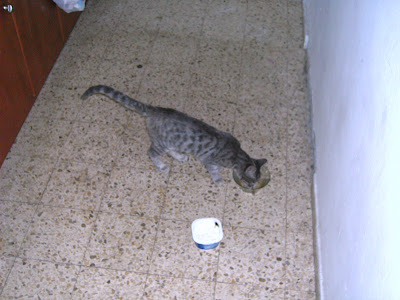
Cat dissing our food
We find some tuna, probably belonging to DB. We give it to the cat. The cat eats it and stops meowing. We throw it in the bedroom, give it a bed. I walk out. Suddenly, I hear a cry of pain from Dan. I walk back in and the cat is flying around the room, attacking any vertical surface with its claws. We don't have string, so I play with it with a long piece of toilet paper until it passes out on a nest of toilet paper shreds. I decide I am a good cat owner. I leave.
Fast forward a few hours. I come back to DB ranting about how we did not consult him about bringing a cat in the room, and how it better stay in our room. I reply that I understand it bothers him, but on the other hand he can go tell the Jewish Agency that we already have four beings living in our room, and then maybe they won't send another roommate. This makes him slightly happier, until he realizes that it is ridiculous. He walk into our room, and picks up the cat, which scratches him fiercely. He announces that he is going to get rid of the cat. We laugh and say whatever. He tells us that it's a safety and health hazard, and that cats are like Israeli rats. We point out that the cat will eat Israeli rats. Unconvinced, DB picks up the cat and takes it outside. We are shocked by his lack of humanity. He feels completely justified. We feel better about feeding the cat his tuna.
So the cat is gone. But now that I think about it, it really resembled one some friends of mine in the building adopted before they left. I played with it before, and, surprise, it showed up at our apartment. So I have every belief that it will be back. And when it is, we may shave it against the heat. On DB's bed.
I look over at my roommate, Dan, who has also just woken up. He looks like he's trying to wake up from a bad dream. I have two parallel thoughts. One: I never, ever want to wake up to this again. Russians are scary, especially in your apartment. Two: cat?
Israel in general and Jerusalem in particular are notorious for stray cats; the Middle East had a huge rat problem in the 30s and the British, who were then running the place, solved it with about as much foresight as they solved the rest of the region's problems. They released boatloads of cats. Now, there are no rats, and cats are everywhere. Including, apparently, the Beit Canada Absorbtion Center.
Russian woman kept yelling, so I got up. A small gray cat--probably like 6 months--was sitting on our dining room floor, meowing loudly. Galina--the Russian woman--pointed at the cat and told me to get it out. I scoop up cat and take it out of the apartment. Galina keeps yelling something about a new roommate coming, presumably not the cat. I smile and nod until she walks out.
Cat under bed
Dan walks over. We confer. We decide three things:
- The cat is cute,
- The cat clearly chose us, using apparently magical powers to get through a locked door,
- Our keeping the cat will really, really piss off the Jewish Agency, as well as our obnoxious, anal-retentive religious roommate, DB, who flips if there is dirt on his soap. If he (cat or DB) stays, there will be trouble.
Cat dissing our food
We find some tuna, probably belonging to DB. We give it to the cat. The cat eats it and stops meowing. We throw it in the bedroom, give it a bed. I walk out. Suddenly, I hear a cry of pain from Dan. I walk back in and the cat is flying around the room, attacking any vertical surface with its claws. We don't have string, so I play with it with a long piece of toilet paper until it passes out on a nest of toilet paper shreds. I decide I am a good cat owner. I leave.
Fast forward a few hours. I come back to DB ranting about how we did not consult him about bringing a cat in the room, and how it better stay in our room. I reply that I understand it bothers him, but on the other hand he can go tell the Jewish Agency that we already have four beings living in our room, and then maybe they won't send another roommate. This makes him slightly happier, until he realizes that it is ridiculous. He walk into our room, and picks up the cat, which scratches him fiercely. He announces that he is going to get rid of the cat. We laugh and say whatever. He tells us that it's a safety and health hazard, and that cats are like Israeli rats. We point out that the cat will eat Israeli rats. Unconvinced, DB picks up the cat and takes it outside. We are shocked by his lack of humanity. He feels completely justified. We feel better about feeding the cat his tuna.
So the cat is gone. But now that I think about it, it really resembled one some friends of mine in the building adopted before they left. I played with it before, and, surprise, it showed up at our apartment. So I have every belief that it will be back. And when it is, we may shave it against the heat. On DB's bed.
Wednesday, July 18, 2007
What Now?
So the winds are turning cold, birds are flying south, and Beit Canada is filling with new immigrants. It's about time for me to move on. Actually, I may not have a choice soon--I just got a notice from the absorption center that if I don't, they will kick me out. I'm quaking in my sandals.
I finish my JPost internship on Thursday, which means I'm essentially done now but am still hanging out in the office, waiting for the Jordanian Ministry of Antiquities to call me back, which really means looking busy while taking advantage of free internet. I've been spectacularly unmotivated this week; I've only gotten one mediocre story out, and even that should have gone out Friday, except that I was spectacularly hung-over (secondary consequence of a week spent dealing with the Israeli government). Oh, and it being the weekend, no one would return my calls.
If you're interested, the last few stories I've written that I'm at all proud of are here, here, here, and here, with that last being another Daily Texan editorial.
So I finish the internship Thursday, and then God knows what I'll do the next three weeks. I'm thinking a hiking trip in the Golan, maybe chilling in Tel Aviv, traveling across the West Bank by camel, whatever. Something like that. Basically, I have no idea what to do with myself, which, at the moment, feels very nice.
So I'm calling on the three people who read this blog--you know who you are--to tell me what to do with myself for the next three weeks, 'go fuck' being an acceptable but kind of juvenile answer. Come on, it'll be fun. Like a contest. With the added benefit of horrible guilt if I take your advice and it kills me.
I finish my JPost internship on Thursday, which means I'm essentially done now but am still hanging out in the office, waiting for the Jordanian Ministry of Antiquities to call me back, which really means looking busy while taking advantage of free internet. I've been spectacularly unmotivated this week; I've only gotten one mediocre story out, and even that should have gone out Friday, except that I was spectacularly hung-over (secondary consequence of a week spent dealing with the Israeli government). Oh, and it being the weekend, no one would return my calls.
If you're interested, the last few stories I've written that I'm at all proud of are here, here, here, and here, with that last being another Daily Texan editorial.
So I finish the internship Thursday, and then God knows what I'll do the next three weeks. I'm thinking a hiking trip in the Golan, maybe chilling in Tel Aviv, traveling across the West Bank by camel, whatever. Something like that. Basically, I have no idea what to do with myself, which, at the moment, feels very nice.
So I'm calling on the three people who read this blog--you know who you are--to tell me what to do with myself for the next three weeks, 'go fuck' being an acceptable but kind of juvenile answer. Come on, it'll be fun. Like a contest. With the added benefit of horrible guilt if I take your advice and it kills me.
Friday, July 6, 2007
Mount Sinai, Bedouin, and Russian Tour Groups
When Moses walked up Mount Sinai to talk to God, the first words he heard were not, I think, "I am the Lord Your God." They were not, "Thou shalt have no other gods before me." No, if Moses' experience at the holy mountain was anything like mine, the first words he heard were something like "Mister, mister, you want buy keffiyeh?"
My travel buddy Roma and I arrived at the base of the mountain at two in the morning to find it crawling with tourists and local Bedouin trying to sell scarves.
"Buy keffiyeh," one of the Bedouin men said, pushing a head scarf at me. "Only twenty pounds."
"La, shukran," I said, exhausting my store of Arabic.
"No, buy," he said. "Is cold at the top of the mountain, and all your money will not keep you warm."
I felt it. Synthetic. "What's it made of?" I asked.
The Bedouin smiled through stained teeth. "Keffiyeh," he said. "Like Arafat. Yassir Arafat? You know?"
Now there's a good selling point. I laughed. "Oh, this is Arafat's keffiyeh?"
He nodded, not understanding. "Yes, Arafat."
I walked away. God only knows the bad karma involved in buying Arafat's old keffiyeh. And besides, I was dissapointed in the man. I would have thought he had too much class to wear polyester.
Roma and I had pulled an all-nighter to catch the minibus from our hotel in Dahab out to Jebel al-Mousa (Mount Moses), which the Bedouin say is the biblical Mount Sinai. The mountain lies about about fifty miles inland, on the other side of a wall of shield mountains that separate it from the coast. It is desert in the purest sense, which means that it is very, very hot very, very early in the day. So to climb it without dying of dehydration, you go at night, make the punishing hike to the summit, catch the sunrise, then speed down before it gets to hot. It would be a solitary, spiritual experience. This, at least, was the plan. We hadn't figured on the Bedouin, or the camels, or the Russian Orthodox tour group.
(Sidebar: The Bedouin having lived in the area for centuries, it seems like they would have the best claim as to the location of any mountain. On the other hand, though, it's not clear whether the Bedouin were in the area before the Arab Conquest fifteen hundred years ago, which most sources would put a while after the Revelation at Sinai. It may be that the Bedouin aren't quite the authorities on the subject they would have you believe--these are the same people who say Aaron is buried at Petra.)
Around two-thirty we started up the mountain. The moon was still almost full and the desert landscape glowed with a pearly light. The white sand path was easy to see, so we could hike fast without worrying about wandering off it. We passed Saint Catherine's, a Byzantine-era monastery about half a mile up the path, and ran directly into the camels.
The way up to the summit, we discovered, is very long--most people take about two-and-a-half to three hours to do it, although a decent hiker can do it in two. So the Bedouin sell camel rides up and down so that the lazy or out-of-shape can see the top without dying. There must be many of these, because in the course of the hike I counted easily a hundred camels, perhaps more. At first--near the bottom--the Bedouin would try to stop you and ask 'Mister, do you want ride gammel?' Later, they dropped even that formality and walked by saying 'Gammel," much in the small-time drug dealers say "Crack," or "X," walking off if you didn't respond quickly.
One saw me and Roma, gestured at her, and said, "Gammel for your wife?"
"Trade?" I asked. Roma shot me a dirty look. Whatever. She wasn't going to carry me and my bags up the mountain and donate hair for making carpets.
"No, no. Ride."
"Why not? I give you her, you give me camel. She cook, she clean, she bear strong Bedouin sons." I have no idea why I was talking like this. It was late.
"No, no good," he said. Then his eyes lit up. "Take camel. Is three hours walk to top. With gammel, only one." Mind, he was leading the camel. Walking. The Bedouin have an interesting way with numbers. Another promised it was two hours walk to the top. One trying to sell me a scarf said it was very cold at the 1250 meter summit, and another next to him swore I would freeze when I reached 2000.
We heard this, or variations of it, most of the way up the mountain. And it was a long way, especially since we spent most of it passing tour groups and camels. The path was narrow, and the camel is reluctant to let you pass. It is also smelly and ill-tempered, so you don't want to get too close. I was alomst run off cliffs several times by the beasts.
As for the mountain? Well, it's spectacular. Around an hour from the summit, you see it soaring above you, a great craggy peak that looks like the work of God Himself. Beneath, lit by moonlight, you see the valley, the path white against the stone, and behind it row on row of mountains. And from there it's a long climb, culminating in seven hundred and fifty--again, taking the Bedouin at their word--slick, rough hewn steps. Each is about a meter wide, though, so you can only go as fast as the slowest person anywhere on the path. And nothing against Russian endurance--I mean, WW2, come on--but there were definitely some slow people on that hike.
Eventually, we got to the top, dug into our halwa (A mixture of sesame oil and honey. All we had for food, since Egyptian grocery stores suck) and sat out to watch the sun rise. Five minutes later, freezing, we realized the sun wouldn't come up for another two hours. We unpacked the sleeping bag, wedged ourselves into a crack in a rock that blocked the wind, and covered ourselves with the bag. I closed my eyes for a second, and woke up two hours later to Japanese voices arguing and light streaming over the mountains.
We got up, opened our eyes. I wrapped myself in a blanket and went to go watch the sun rise. The view was incredible. The Sinai Mountains stretched to infinity like the waves of a stalled sea. And then, just as the sun crested the mountains, every Japanese tourist on the mountain ran to have his or her picture taken against it. And the Russians started singing Orthodox hymns in loud, deep, choral voices. It was time to go. We sped down the mountain.
This is the point where I should reflect on the experience, tell about what it did to my spirit, how I touched the face of God. But really, I'm not at the level where I can have a spiritual experience when surrounded by Japanese tourists, and I'm not even sure the Bedouin have the right mountain. So maybe I should bitch about how tourists ruined a good experience. But I was a tourist too. So I'll close with this: Sinai was an awesome hike. Do it. God is watching. And if you can't make it to the top, well, there's always gammels.
My travel buddy Roma and I arrived at the base of the mountain at two in the morning to find it crawling with tourists and local Bedouin trying to sell scarves.
"Buy keffiyeh," one of the Bedouin men said, pushing a head scarf at me. "Only twenty pounds."
"La, shukran," I said, exhausting my store of Arabic.
"No, buy," he said. "Is cold at the top of the mountain, and all your money will not keep you warm."
I felt it. Synthetic. "What's it made of?" I asked.
The Bedouin smiled through stained teeth. "Keffiyeh," he said. "Like Arafat. Yassir Arafat? You know?"
Now there's a good selling point. I laughed. "Oh, this is Arafat's keffiyeh?"
He nodded, not understanding. "Yes, Arafat."
I walked away. God only knows the bad karma involved in buying Arafat's old keffiyeh. And besides, I was dissapointed in the man. I would have thought he had too much class to wear polyester.
Roma and I had pulled an all-nighter to catch the minibus from our hotel in Dahab out to Jebel al-Mousa (Mount Moses), which the Bedouin say is the biblical Mount Sinai. The mountain lies about about fifty miles inland, on the other side of a wall of shield mountains that separate it from the coast. It is desert in the purest sense, which means that it is very, very hot very, very early in the day. So to climb it without dying of dehydration, you go at night, make the punishing hike to the summit, catch the sunrise, then speed down before it gets to hot. It would be a solitary, spiritual experience. This, at least, was the plan. We hadn't figured on the Bedouin, or the camels, or the Russian Orthodox tour group.
(Sidebar: The Bedouin having lived in the area for centuries, it seems like they would have the best claim as to the location of any mountain. On the other hand, though, it's not clear whether the Bedouin were in the area before the Arab Conquest fifteen hundred years ago, which most sources would put a while after the Revelation at Sinai. It may be that the Bedouin aren't quite the authorities on the subject they would have you believe--these are the same people who say Aaron is buried at Petra.)
Around two-thirty we started up the mountain. The moon was still almost full and the desert landscape glowed with a pearly light. The white sand path was easy to see, so we could hike fast without worrying about wandering off it. We passed Saint Catherine's, a Byzantine-era monastery about half a mile up the path, and ran directly into the camels.
The way up to the summit, we discovered, is very long--most people take about two-and-a-half to three hours to do it, although a decent hiker can do it in two. So the Bedouin sell camel rides up and down so that the lazy or out-of-shape can see the top without dying. There must be many of these, because in the course of the hike I counted easily a hundred camels, perhaps more. At first--near the bottom--the Bedouin would try to stop you and ask 'Mister, do you want ride gammel?' Later, they dropped even that formality and walked by saying 'Gammel," much in the small-time drug dealers say "Crack," or "X," walking off if you didn't respond quickly.
One saw me and Roma, gestured at her, and said, "Gammel for your wife?"
"Trade?" I asked. Roma shot me a dirty look. Whatever. She wasn't going to carry me and my bags up the mountain and donate hair for making carpets.
"No, no. Ride."
"Why not? I give you her, you give me camel. She cook, she clean, she bear strong Bedouin sons." I have no idea why I was talking like this. It was late.
"No, no good," he said. Then his eyes lit up. "Take camel. Is three hours walk to top. With gammel, only one." Mind, he was leading the camel. Walking. The Bedouin have an interesting way with numbers. Another promised it was two hours walk to the top. One trying to sell me a scarf said it was very cold at the 1250 meter summit, and another next to him swore I would freeze when I reached 2000.
We heard this, or variations of it, most of the way up the mountain. And it was a long way, especially since we spent most of it passing tour groups and camels. The path was narrow, and the camel is reluctant to let you pass. It is also smelly and ill-tempered, so you don't want to get too close. I was alomst run off cliffs several times by the beasts.
As for the mountain? Well, it's spectacular. Around an hour from the summit, you see it soaring above you, a great craggy peak that looks like the work of God Himself. Beneath, lit by moonlight, you see the valley, the path white against the stone, and behind it row on row of mountains. And from there it's a long climb, culminating in seven hundred and fifty--again, taking the Bedouin at their word--slick, rough hewn steps. Each is about a meter wide, though, so you can only go as fast as the slowest person anywhere on the path. And nothing against Russian endurance--I mean, WW2, come on--but there were definitely some slow people on that hike.
Eventually, we got to the top, dug into our halwa (A mixture of sesame oil and honey. All we had for food, since Egyptian grocery stores suck) and sat out to watch the sun rise. Five minutes later, freezing, we realized the sun wouldn't come up for another two hours. We unpacked the sleeping bag, wedged ourselves into a crack in a rock that blocked the wind, and covered ourselves with the bag. I closed my eyes for a second, and woke up two hours later to Japanese voices arguing and light streaming over the mountains.
We got up, opened our eyes. I wrapped myself in a blanket and went to go watch the sun rise. The view was incredible. The Sinai Mountains stretched to infinity like the waves of a stalled sea. And then, just as the sun crested the mountains, every Japanese tourist on the mountain ran to have his or her picture taken against it. And the Russians started singing Orthodox hymns in loud, deep, choral voices. It was time to go. We sped down the mountain.
This is the point where I should reflect on the experience, tell about what it did to my spirit, how I touched the face of God. But really, I'm not at the level where I can have a spiritual experience when surrounded by Japanese tourists, and I'm not even sure the Bedouin have the right mountain. So maybe I should bitch about how tourists ruined a good experience. But I was a tourist too. So I'll close with this: Sinai was an awesome hike. Do it. God is watching. And if you can't make it to the top, well, there's always gammels.
Thursday, June 28, 2007
My Journeys Begin
Jerusalem being too quiet, what with the near-riots and all, I am going backpacking through Jordan and Egypt.
It should go something like this: North through Israel to Beit Shean, cross at the border and work my way south through Jordan to Wadi Rum, then west to Aqaba, crash back in Israel, in Eilat, then west across the Sinai to Cairo and south along the Nile to Luxor and Aswan. Then I'll work my way back, see a lot of Cairo, the Delta, and Sinai. Hoping for a nightime climb up Mount Sinai, as well...divine revelation remains a possibility.
Should all take about two-ish weeks.
All this is a long way of saying: I'll be out of touch for a while, but with good reason. There may or may not be occasional posts.
Don't miss me too much, now.
It should go something like this: North through Israel to Beit Shean, cross at the border and work my way south through Jordan to Wadi Rum, then west to Aqaba, crash back in Israel, in Eilat, then west across the Sinai to Cairo and south along the Nile to Luxor and Aswan. Then I'll work my way back, see a lot of Cairo, the Delta, and Sinai. Hoping for a nightime climb up Mount Sinai, as well...divine revelation remains a possibility.
Should all take about two-ish weeks.
All this is a long way of saying: I'll be out of touch for a while, but with good reason. There may or may not be occasional posts.
Don't miss me too much, now.
Sunday, June 24, 2007
Keeping the Peace in the Holy City
The Gay Pride Parade, Part II
The parade was an anticlimax. Other than one counter-demonstrator holding signs wishing the marchers a complete recovery (presumably from their perversion) and pointing out that there was, in fact, “NO PRIDE IN SHAME!!” the religious opponents of the parade were absent. Actually, 'parade' is kind of a misnomer—it was more like a semi-directed rainbow mob. There was no organization—marchers milled around for a full half hour after the event was supposed to start. Finally, the police told them to start moving already, so they demonstrators marched haphazardly down a mile or so of King David Street, finishing finally in front of the King Solomon hotel. That was it.
It was an intensely depressing experience, for a couple of reasons. First, because the parade was super lame. Second, and more importantly, because it was so quiet.
Now, let me clarify that. Despite my desire to see burning cars, I can acknowledge that it's a good thing no one died. I may have been, as several ex-girlfriends will happily confirm, born without a heart, but I can agree that people dying is, generally, a bad thing. Even people getting rocks thrown at them is a bad thing. This said, two questions need to be asked. First: Why, exactly, did no one die? And second: What did it all prove?
Here's why it was quiet. When I was writing my first piece on this yesterday morning, right next to where the parade would finish, the street was already filled with uniformed police, their riot gear laying out on the sidewalk. When I was downtown, far from where the parade would start, at around two, far beforehand, there were dozens more. And when I say police, I don't just mean your normal blue-shirted, cop-on-the-beat variety, although they were there too. There were also heavily armed riot police, in full armor, with shields, billy clubs, and assault rifles. Some rode horses, the better to break up a riot. And riding around on motorcycles were members of Israel's SWAT equivalent, trained to roll off a motorcycle at 60 kph while firing an M4. Which sounds more like a Bad Boys movie than a workable system of law enforcement, but then I kind of suspect there are some things that the Israeli military trains its people do just, you know, because they're cool.
The point, however, is that the Jerusalem municipality took no chances. It deployed 8000 police, MPs, and border guards to lock down the downtown area. (Just to understand the resources this involved, the Israeli Army has, on active duty, something like 10,000 combat infantry). They closed off the streets with roadblocks, parked buses sideways to create choke points, screened every person who walked onto King David street for weapons. Beards, too—I saw a few haredim turned away from the entrance by the police.
You begin to see, I hope, why this is so depressing. Because there are really only two possibilities here, neither good. One, is that all of the manpower, the time, the expense—13 million NIS, or $3.25 million—was, as some Jerusalemites say, a big waste of the city and national government's scant funds. The other is that it wasn't. That the only thing that kept the parade from degenerating into an orgy of violence and blood was 8000 heavily armed cops.
I don't know which is true. I do know this: despite everything, the police arrested more than two dozen haredim who tried to “disrupt the parade,” through means ranging from throwing eggs to—in one case—attempting to smuggle in a bomb. One was arrested for trying to get in “dressed as a homosexual,” to uncertain purpose. I'm not entirely sure what this means, or what he was trying to do, but I'd kind of like to see a picture.
I would like to believe that the fact that it came off quietly was a result of enlightened progressivism on the part of the city's religious. I would like to believe that it shows that Jerusalem is not a city totally gone mad. I would like to believe the parade proved something.
At least, I would like to believe it proved something beyond this: when people in Jerusalem don't like each other, there can still be peace—as long as you have roadblocks, and soldiers, and cops. But at the end of the day, nothing was proven. Not that the city needs to learn a lesson about tolerance, not that the government can stop freaking out over the idea of a gay pride parade here.
I don't want to say that it would be better if the police hadn't been there and the parade come to its natural, bloody conclusion. I don't want to say it would have been better if it had been canceled. But after all the argument, all the demonstrations, all the money spent, the city is the same as if it had never happened. And it's not in any way clear what the hell the point was.
Subscribe to:
Posts (Atom)